
Automatically translated from Korean. Read the Korean original
Hello, I am Veteran Law Firm attorney Seung-yoon Oh.
It is common for family members and people close to one another to look after belongings for someone else. If the relationship breaks down, however, this can lead to a theft complaint. The starting point is that taking an item does not, by itself, establish theft.
This article explains when theft is established. I also introduce a recent case I handled during the investigation that ended with a decision not to refer the case to the prosecution.
Key points
Theft is punishable by imprisonment for up to 6 years or a fine of up to KRW 10,000,000. Taking another person's property alone is insufficient: there must also be an intention to use it as one's own. Investigators assess this by examining who actually owns the item, whether permission was given, and the circumstances in which it was taken.
1. Elements of Theft and Applicable Penalties
What is theft?
Theft involves taking property possessed by another person against that person's wishes. The legal basis is 형법 제329조. In addition to cash and physical goods, documents such as contracts can be the subject of theft if they have property value.
Elements of the offense
| Element | Explanation |
|---|---|
| Object | An item owned by someone else and possessed by another person |
| Conduct | Transferring possession against that person's wishes |
| Intent | Awareness that one is taking another person's property |
| Intent to appropriate unlawfully | Excluding the owner and intending to use or dispose of the item as one's own |
The last row is what I examine first in a theft case. Even where an item was taken, theft is not established without an intent to appropriate it unlawfully. That intent may be absent if the owner gave permission or the item was taken to keep it safe for the owner.
Applicable penalties
| Category | Applicable provision | Penalty |
|---|---|---|
| Theft | 형법 제329조 | Imprisonment for up to 6 years or a fine of up to KRW 10,000,000 |
| Attempted theft | 형법 제342조 | Attempts are also punishable |
| Theft between relatives | 형법 제344조, 제328조 | Prosecution requires a complaint by the victim |
Property offenses between family members were previously exempt from punishment. The law changed on 2025년 12월, however, and punishment is now possible if the victim files a complaint. A matter cannot be assumed to be safe from prosecution simply because it concerns family members.
2. Responses for Different Situations

① When an item was taken with the owner's permission
The key question is who actually owns the item. If the person who filed the complaint is not the owner, the actual owner's permission becomes important evidence.
- When and how permission was obtained
- The statement of the person who gave permission
- Documents showing ownership of the item
- How the item was kept after it was taken
If permission was given only orally, the statement of the person who gave it is particularly important. I therefore first work out how to convey that statement to investigators.
② When an item was taken for safekeeping or return
If the purpose was safekeeping or protection, an intent to appropriate unlawfully may be absent. That explanation must, however, be supported by objective circumstances.
It matters whether the item was used or disposed of after it was taken. Keeping it in a condition in which it could be returned at any time is a favorable circumstance.
③ When a complaint arises from a family dispute
In family disputes, complaints are often filed while emotions are running high. It is therefore important to explain matters by separating the facts from emotions.
It is better to focus on ownership and permission than to criticize the other person. These are ultimately the matters on which investigators base their assessment.
④ When contacted for questioning
Your account should be consistent from the first interview. Concealing or denying the fact that the item was taken may instead undermine credibility.
It is advisable to acknowledge taking the item while clearly explaining why it was taken. I recommend organizing the relevant material before questioning.
3. A Case in Which Counsel Assisted
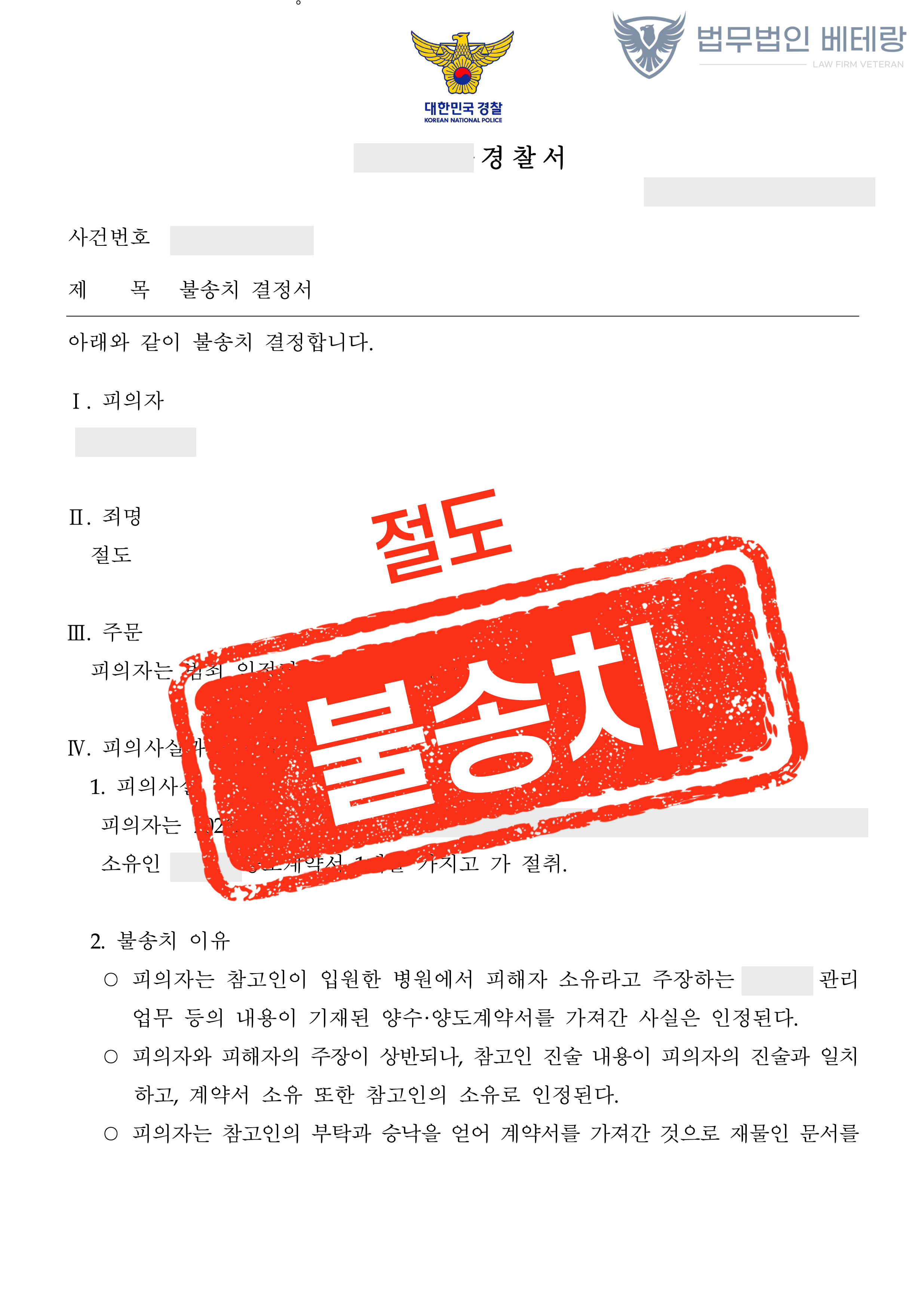
Documents taken at a family member's request: no referral to the prosecution (no suspicion of an offense)
I represented the client during the investigation in this case. Information that could identify the client has been changed or omitted.
Case overview
At her hospitalized husband's request, the client collected documents he had been keeping. Another person involved in a family dispute then claimed to own those documents and filed a theft complaint against the client.
Issues I identified in this case
I identified two issues: who actually owned the documents, and whether the client had an intent to appropriate them unlawfully.
Assistance provided as defense counsel
I first established the circumstances showing that the documents belonged to the husband. I then explained that the client had taken them at her husband's request and with his consent.
The husband's statement matched the client's account. On that basis, I explained that the client had no intention of making the documents her own.
Outcome
The police found that the documents belonged to the husband and that the client had taken them at his request and with his consent. They also found no intent to commit theft or to appropriate the documents unlawfully. The result was a decision not to refer the case to the prosecution (no suspicion of an offense).
This outcome depended on the evidence and facts of this particular case. A similar case is not guaranteed to have the same outcome.
4. Strengths of Veteran Law Firm
① Understanding and responding to the investigation process
We prepare with an understanding of what materials investigators examine and what they seek to establish. Before questioning, we organize the approach to statements and the materials to submit together.
② Carefully organizing the facts
We examine the facts that determine the assessment one by one, including ownership, permission, and how the item was taken. We help ensure that statements from those involved are accurately conveyed to investigators.
③ A response suited to each case
Even under the same charge, the issues vary from case to case. We decide whether to dispute ownership or the intent to appropriate according to the facts.
④ The responsible attorney handles the case from start to finish
The attorney who conducts the consultation handles the case from preparation for questioning through the disposition.
Meet the responsible attorney → View the profile of attorney Seung-yoon Oh
⑤ Offices nationwide
We have offices in Suwon, Seoul, Incheon, Daejeon, Busan, and Gwangju.
5. Frequently Asked Questions
Q. If I did take the item, does that automatically amount to theft?
A. No. The item must belong to someone else, and there must also be an intent to appropriate it unlawfully. Theft may not be established if the owner gave permission.
Q. Can documents with no cash value be the subject of theft?
A. Documents recording legal rights and obligations, such as contracts, can be the subject of theft. It is therefore advisable to make the owner's permission clear before taking documents as well.
Q. Can taking an item between family members lead to punishment?
A. Following the amendment on 2025년 12월, property offenses between family members can also be punished if a complaint is filed. Without a complaint, however, prosecution cannot be brought.
Q. What happens if the complainant objects to a decision not to refer the case?
A. If the complainant files an objection, the case is transferred to the prosecution for another review. It is therefore important to leave a sufficient record of the supporting materials during the investigation.
Closing
A theft complaint may first make you worry, "I did take it, so what should I do?" But the law examines whose property it was and why it was taken, rather than the act of taking it alone.
In family disputes in particular, emotions can obscure the facts. If investigators have contacted you, start by organizing the materials showing permission and ownership.
That concludes this article from Veteran Law Firm attorney Seung-yoon Oh.
Request a consultation
Have investigators contacted you about a theft complaint in Seoul? At the Seoul branch office of Veteran Law Firm, we can review the circumstances and materials with you.
📞 Seoul branch telephone consultation [02-6952-9262]
This article provides general legal information and is not legal advice for an individual matter. Please consult an attorney about your specific case.
Attorney responsible for this advertisement: Managing Attorney Seulki Lee
Request a consultation
Use the form to send a consultation request.