
Automatically translated from Korean. Read the Korean original
Hello, I am Veteran Law Firm attorney Seung-yoon Oh.
There are cases in which a defendant is acquitted by the 1st- and 2nd-instance courts, but the prosecutor then appeals to the Supreme Court. Many people worry, "What if the Supreme Court overturns the result?" However, the Supreme Court does not re-examine the facts from the beginning.
This article explains the penalties for violations of the debt collection law and the Supreme Court appeal system. I also introduce a case I handled from the appellate stage in which the Supreme Court dismissed the prosecutor's appeal.
Key points The debt collection law imposes criminal penalties for unlawful collection practices such as violence, threats, and repeated contact. To establish guilt, however, it must first be proved that the defendant was the person who carried out the collection. Even when a prosecutor appeals an acquittal to the Supreme Court, an argument that merely disputes findings of fact is not a lawful ground for that appeal.
1. Elements of a Debt Collection Law Violation and Applicable Penalties
What is the debt collection law?
Its formal name is the Fair Debt Collection Practices Act (채권의 공정한 추심에 관한 법률). It is intended to prevent conduct during debt collection that disrupts the lives of debtors and their families. It applies not only to moneylending businesses but also to loans between individuals.
Prohibited collection practices
| Category | Statutory provision | Conduct |
|---|---|---|
| Violent collection | 제9조 제1호 | Collection involving assault, threats, arrest, confinement, deception, or coercive force |
| Repeated or nighttime contact | 제9조 제2호, 제3호 | Repeated or nighttime contact without justifiable grounds that causes fear |
| Demanding payment from a 3rd party | 제9조 제4호, 제5호 | Compelling a debtor to borrow elsewhere to repay the debt or demanding payment from family members who have no obligation to pay |
| Contacting related persons | 제8조의3 | Contacting family members or coworkers for purposes other than locating the debtor |
Applicable penalties
| Category | Applicable provision | Penalty |
|---|---|---|
| Violent collection | 채권추심법 제15조 제1항 | Imprisonment for up to 5 years or a fine of up to KRW 50,000,000 |
| Repeated or nighttime contact and similar conduct | 채권추심법 제15조 제2항 | Imprisonment for up to 3 years or a fine of up to KRW 30,000,000 |
| Contacting related persons | 채권추심법 제15조 제3항 | Imprisonment for up to 1 year or a fine of up to KRW 10,000,000 |
Unlawful collection cases are often prosecuted together with violations of the moneylending law, for example where money was lent without registration or interest exceeded the statutory maximum. It is therefore necessary first to identify which charges are being brought together.
How far can a prosecutor's appeal to the Supreme Court go?
| Category | Legal basis | Explanation |
|---|---|---|
| Grounds for appeal to the Supreme Court | 형사소송법 제383조 | Limited to grounds such as a violation of law that affected the judgment |
| Errors of fact | 형사소송법 제383조 제4호 | A ground for appeal only in cases involving sentences such as imprisonment with or without labor for 10 years or more |
| Free evaluation of evidence | 형사소송법 제308조 | The probative value of evidence is left to the judge's free assessment |
| Dismissal of an appeal by order | 형사소송법 제380조 제2항 | If the absence of grounds for appeal is clear, the appeal may be dismissed by order |
This table covers what I examine first in a Supreme Court appeal. In principle, the Supreme Court does not reassess how the lower courts evaluated the evidence. It therefore matters whether the prosecutor's grounds challenge findings of fact or legal principles.
2. Responses for Different Situations

① When disputing that you were the person involved
In unlawful collection cases, the identity of the person who actually carried out the collection may be disputed. Contact is often made using phones registered under other people's names, and money moves through accounts held under other names.
- Whether the victim's recollection of the person's appearance matches the defendant's actual appearance
- Who actually used the telephone number used for collection
- Whether call-location records match the defendant's movements
- Who actually managed the bank account
Even if there are circumstances that investigators consider suspicious, a conviction is not possible while reasonable doubt remains. I therefore examine what each suspicious circumstance actually proves.
② When the victim identifies someone from a photograph
Sometimes a victim is shown only a single photograph of a suspect and asked whether that person was the offender. The Supreme Court regards identification in this manner as having low reliability (Supreme Court judgment dated 2008. 1. 17., case 2007도5201). Human memory has limits, and simply being shown the photograph may suggest that the person pictured is the offender.
It is therefore necessary to check how the identification was conducted and compare the victim's initial account of the person's appearance with the actual appearance.
③ When the prosecutor appeals an acquittal at the 1st instance
At the appellate stage, it is necessary to identify exactly which parts of the 1st-instance judgment the prosecutor disputes. It is also necessary to check whether new evidence will be introduced or witnesses examined. The 1st-instance judgment is the starting point for responding to the appeal. Counsel should set out why the 1st-instance court acquitted the defendant and explain whether the prosecutor's arguments actually undermine those reasons.
④ When the prosecutor appeals an acquittal at the 2nd instance to the Supreme Court
On receiving the prosecutor's statement of grounds for appeal, first distinguish the nature of each argument: does it concern a legal issue, or does it ask for the evidence to be evaluated again? If the argument challenges the evaluation of evidence, it is necessary to explain why it is not a lawful ground for a Supreme Court appeal. At the same time, it is prudent to rebut the substance of each argument individually.
3. A Case in Which Counsel Assisted
Acquittal on the debt collection law charge: prosecutor's Supreme Court appeal dismissed
I handled this case at the appellate and Supreme Court stages. Information that could identify the client has been changed or omitted.
Case overview
The client was charged with violating the debt collection law, together with unlawful moneylending. The allegation was that the client had lent money to the victim and carried out unlawful collection. The court at the 1st instance acquitted the client on the debt collection law charge. The prosecutor appealed, and I took on the case from that point. At the appellate stage, the prosecutor's appeal was also dismissed.
The prosecutor then appealed again to the Supreme Court.
Issues I identified in this case
The central issue was whether the client was the person who collected the debt from the victim. The Supreme Court appeal added another issue: whether the prosecutor's grounds were matters the Supreme Court could examine.
Assistance provided as defense counsel
I first examined what the prosecutor's grounds for appeal challenged. Ultimately, they disputed the evaluation of evidence and findings of fact in the 1st and 2nd instances. I also cited Supreme Court precedents establishing that such arguments are not lawful grounds for an appeal to the Supreme Court.
I then submitted a written opinion rebutting each of the prosecutor's grounds separately. I also explained that most of those arguments had already been rejected at the appellate stage.
Outcome
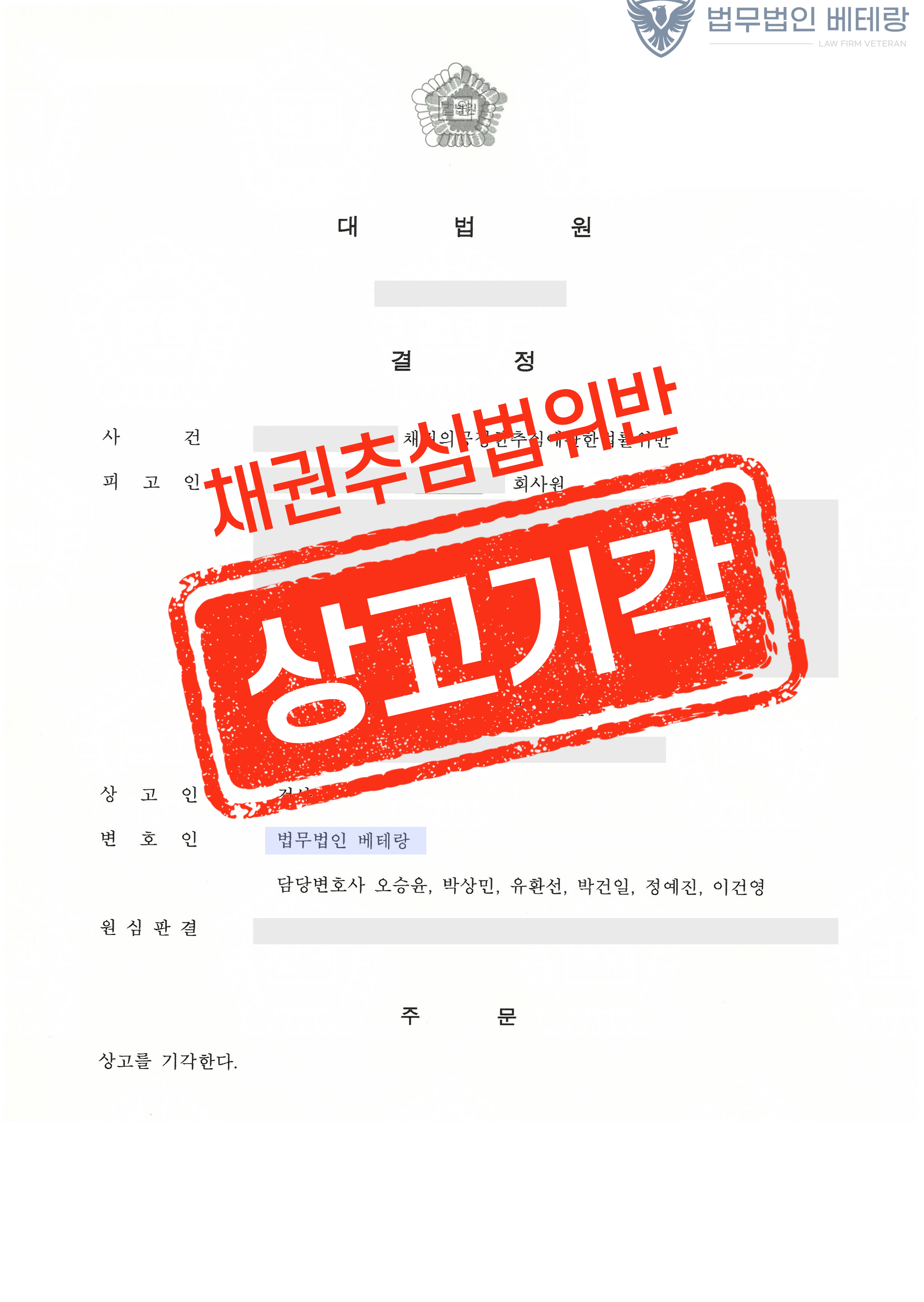
On 2026년 11월, the Supreme Court issued an order dismissing the prosecutor's appeal. It explained that arguments criticizing the lower court's evaluation of evidence and findings of fact were not lawful grounds for a Supreme Court appeal. The acquittal on the debt collection law charge became final.
This outcome depended on the evidence and facts of this particular case. A similar case is not guaranteed to have the same outcome.
4. Strengths of Veteran Law Firm
① Representation from the investigation through the Supreme Court appeal
Investigations, 1st-instance proceedings, appellate proceedings, and Supreme Court appeals each require different approaches. Whatever stage a case has reached, we prepare a response suited to that stage.
② Examining what the evidence actually proves
Even when many circumstances appear suspicious, each item of evidence has its own limits. We carefully examine the significance of each telephone number, bank account, and statement.
③ A response suited to each case
Even under the same charge, the issues vary from case to case. We decide whether to dispute the identity of the person involved or the legal principles according to the facts.
④ The responsible attorney handles the case from start to finish
The attorney who conducts the consultation handles the case from engagement until the judgment becomes final.
Meet the responsible attorney → View the profile of attorney Seung-yoon Oh
⑤ Offices nationwide
We have offices in Suwon, Seoul, Incheon, Daejeon, Busan, and Gwangju.
5. Frequently Asked Questions
Q. Is the case over immediately after an acquittal at the 1st instance?
A. No. The prosecutor may appeal an acquittal to the appellate court and the Supreme Court. It is necessary to continue responding until the judgment becomes final.
Q. If the prosecutor appeals to the Supreme Court, will there be another trial?
A. The Supreme Court mainly examines whether there has been a violation of law. In principle, evaluation of the evidence belongs to the courts in the 1st and 2nd instances.
Q. Is dismissal by an "order" different from dismissal by a "judgment"?
A. If the absence of grounds for appeal is clear, the Supreme Court may dismiss the appeal by order without oral argument. In either case, the lower court's judgment becomes final as it stands.
Q. Does the debt collection law apply to loans between individuals?
A. Yes. It also applies to loans between individuals. Individual creditors must therefore take care with their collection methods.
Closing
When proceedings continue in a higher court after an acquittal, the time may feel long and exhausting. However, the scope of issues that can be disputed is defined for each higher stage. First examine what the prosecutor disputes and whether the argument is permitted at that stage. Continue responding in a manner suited to each stage until the judgment becomes final. That concludes this article from Veteran Law Firm attorney Seung-yoon Oh.
Request a consultation
Are you facing an appellate or Supreme Court appeal concerning a debt collection law violation in Seoul? At the Seoul branch office of Veteran Law Firm, we can review the judgment and supporting materials with you.
📞 Seoul branch telephone consultation [02-6952-9262]
This article provides general legal information and is not legal advice for an individual matter. Please consult an attorney about your specific case.
Attorney responsible for this advertisement: Managing Attorney Seulki Lee
Request a consultation
Use the form to send a consultation request.